2026 Mapping Power and Language Access in the UNC Healthcare System
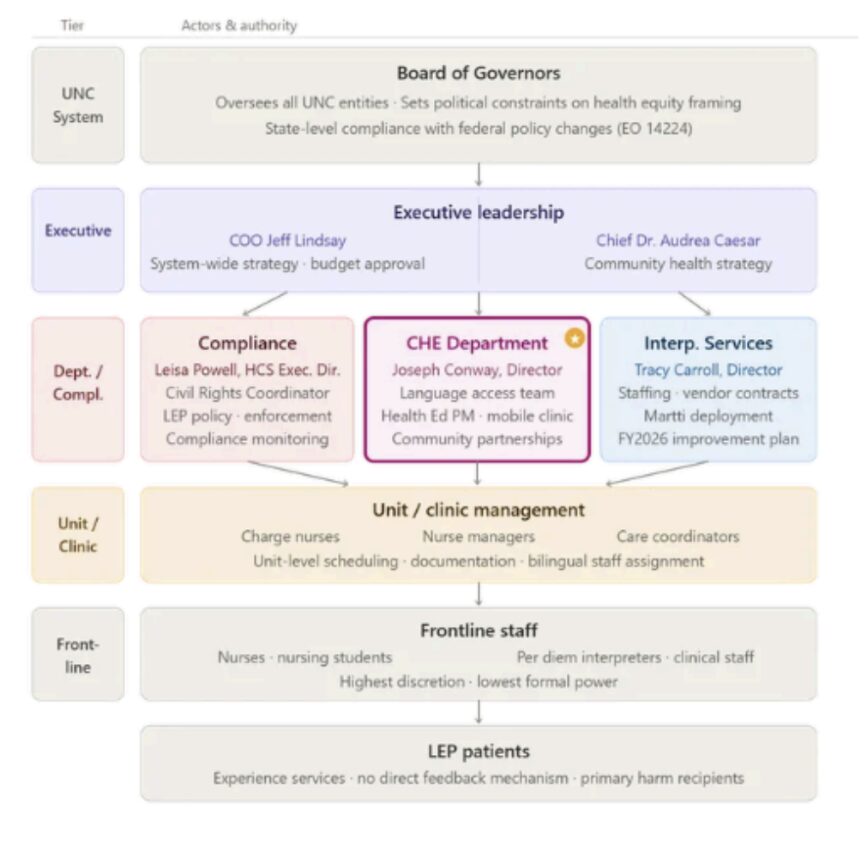
This project was conducted in partnership with the Refugee Community Partnership (RCP), an Orange County-based nonprofit serving over 1,200 refugee and immigrant community members across the Triangle. This capstone investigates the gap between what the law mandates, what UNC Health says it provides, and what patients and navigators actually experience, and equips RCP with the evidence, stakeholder knowledge, and strategic recommendations to advocate for meaningful change.
Health Savings from Translation Services: A Systematic Review (2026)
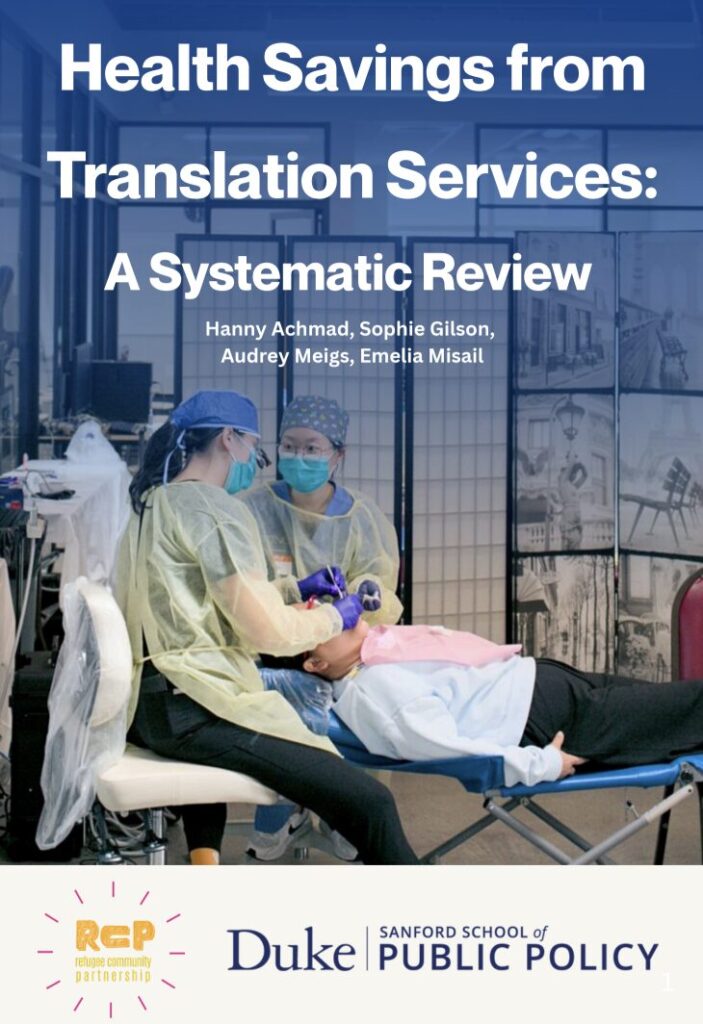
This final report examined the lack of data regarding language access services and finacialization data in healthcare. To address this need, the team conducted a systematic review of existing research on health cost savings from language services. Articles had to include empirical data, language services in a United States health department setting, report robust economic outcomes, and be published between 2004 and 2026 in English. The team determined that there is limited data regarding cost savings from translation services in healthcare systems. Out of 4,476 articles across three large databases, two were included in the final synthesis. This systematic review highlights the need for more research on cost-savings estimates rendered from language services in healthcare systems.
Final Report: Oral Health Policy Advocacy Pathways
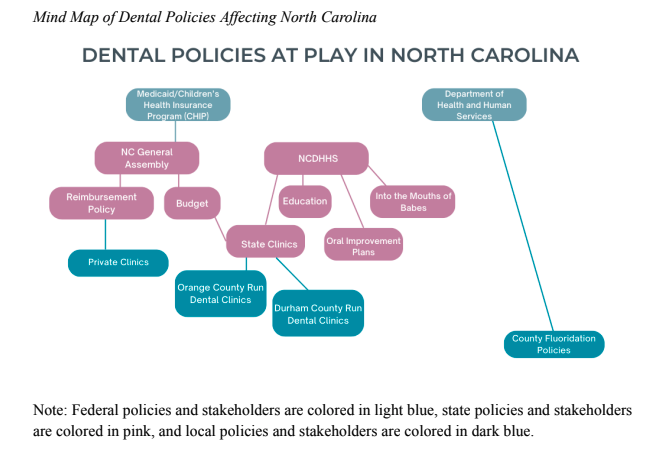
This report created by a team of public policy students provides a comprehensive overview of the oral health policy landscape as it pertains to refugee communities in North Carolina. First, they examined survey data evaluating Refugee Community Partnership’s (RCP) volunteer Language Navigator program and conduct a literature review discussing relevant political conditions, barriers, and past oral health policy interventions. Then they presented thematic conclusions and a power map relying on a series of nineteen interviews conducted with oral health policy stakeholders in North Carolina. Considering RCP’s positionality in the oral health policy landscape, they conclude with a series of recommendations regarding potential advocacy avenues.
Language Justice in Duke Emergency Departments: Legal, Financial, and Strategic Considerations
“This report examines 3 primary questions: Is Duke University Health System (DUHS) legally compliant with Title VI and Section 1557 in its provision of language services in its emergency departments?
What are the explicit and hidden financial benefits associated with improved language access in Duke EDs?
What evidence-based strategies can enhance language justice in Duke EDs while strengthening institutional performance? “
Illuminating the Shadows: Refugee and Migrant-Led Analysis of Language In-access in Health Care as a Product of White Structural and Cultural Dominance
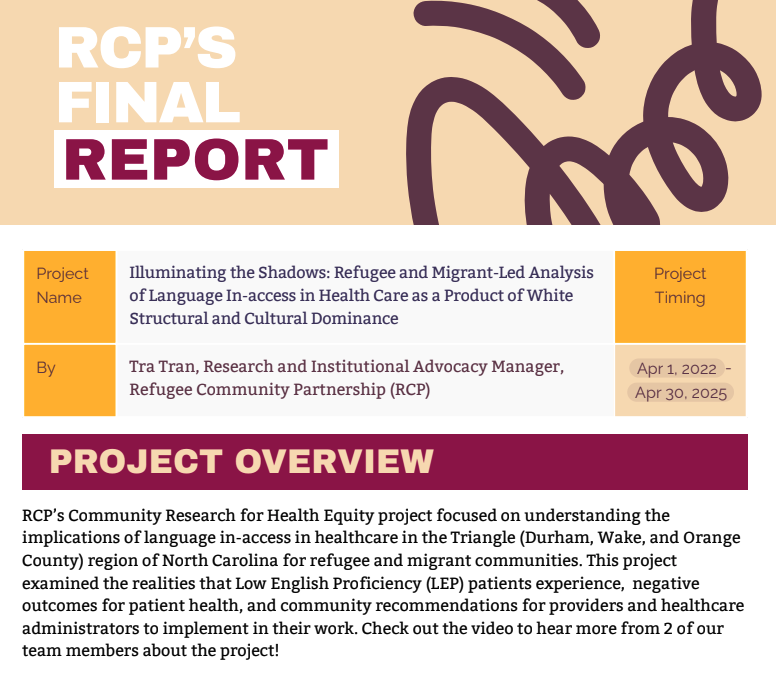
RCP’s Community Research for Health Equity, funded by the Robert Wood Johnson Foundation, project focused on understanding the implications of language in-access in healthcare in the Triangle (Durham, Wake, and Orange County) region of North Carolina for refugee and migrant communities. This project examined the realities that Low English Proficiency (LEP) patients experience, negative outcomes for patient health, and community recommendations for providers and healthcare administrators to implement in their work. Our project, conducted over the course of 3 years, used a community-based participatory method to elucidate insights and recommendations, with data coming from RCP’s seminal Language Navigator (LN) Program, community health forums conducted in people’s primary language, individual interviews conducted using simultaneous interpretation, and language access policy reviews.
Community Research Health Equity (CRHE) Community Report Back in Swahili
This presentation is our way to report back to the Swahili speaking community about the research we conducted with the RWJF CRHE grant. It describes the project’s goals, what we did, what we found, and community recommendations for the healthcare sector to make healthcare more accessible to Low English Proficiency (LEP) patients. The presentation has been translated into 8 languages, and is a mix of audio and written translation.
Community Research Health Equity (CRHE) Community Report Back in Arabic
This presentation is our way to report back to the Arabic speaking community about the research we conducted with the RWJF CRHE grant. It describes the project’s goals, what we did, what we found, and community recommendations for the healthcare sector to make healthcare more accessible to Low English Proficiency (LEP) patients. The presentation has been translated into 8 languages, and is a mix of audio and written translation.
Community Research Health Equity (CRHE) Community Report Back in Kinyarwandan
This presentation is our way to report back to the Kinyarwandan speaking community about the research we conducted with the RWJF CRHE grant. It describes the project’s goals, what we did, what we found, and community recommendations for the healthcare sector to make healthcare more accessible to Low English Proficiency (LEP) patients. The presentation has been translated into 8 languages, and is a mix of audio and written translation.
Community Research Health Equity (CRHE) Community Report Back in Burmese

This presentation is our way to report back to the Burmese speaking community about the research we conducted with the RWJF CRHE grant. It describes the project’s goals, what we did, what we found, and community recommendations for the healthcare sector to make healthcare more accessible to Low English Proficiency (LEP) patients. The presentation has been translated into 8 languages, and is a mix of audio and written translation.
Community Research Health Equity (CRHE) Community Report Back in Karen
This presentation is our way to report back to the Karen speaking community about the research we conducted with the RWJF CRHE grant. It describes the project’s goals, what we did, what we found, and community recommendations for the healthcare sector to make healthcare more accessible to Low English Proficiency (LEP) patients. The presentation has been translated into 8 languages, and is a mix of audio and written translation.